
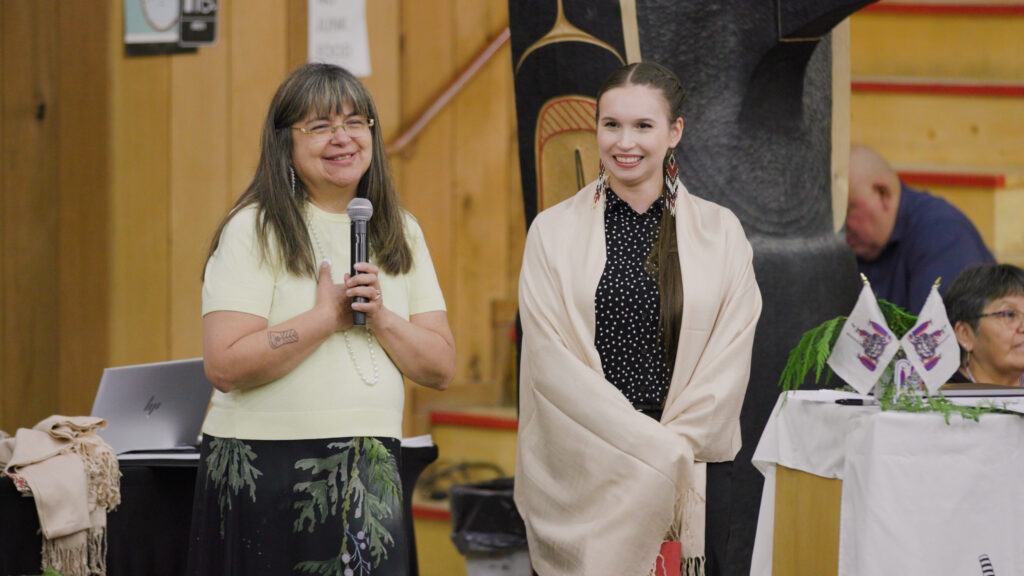
Photo: Chief Councillor Marilyn Slett and Kristen Windsor
Hosted by the Haíɫzaqv (Heiltsuk) Nation in Bella Bella, BC, the Coastal Strong Symposium was initially created to address the possibility of the proposed West Coast Oil Pipeline Project choosing a Northern route through either Prince Rupert, Kitimat, or Fort St. John. Indigenous leaders, advocates, and allies were invited to come together to contemplate and develop next steps in opposing a Northern route. The selection of a Northern route would have threatened the Oil Tanker Moratorium Act, a seven-year-old Act (enacted June 21, 2019) that currently protects the coast from oil tankers carrying more than 12,500 tonnes of crude oil, and other types of oil products. A major concern voiced by Nations was that amending or repealing the Moratorium Act created the possibility of a large, uncontrollable crude oil spill occurring on the coast. As seen during the Nathan E. Stewart spill in Haíɫzaqv territory, the coast is wholly unprepared for oil spills, let alone a large-scale bitumen oil spill which behaves differently from conventional crude oil and is more difficult to manage.
However, after Alberta and Canada opted for a Southern route through Roberts Bank, the Symposium switched gears. During a moment of ‘reprieve’, the Symposium focused on a proactive approach to implementing Indigenous legal orders and governance to address environmental concerns, protection and stewardship in an era where Canada continues to threaten traditional, cultural and integral aspects of Indigenous identity through major project developments.
Day One
The Symposium started with a traditional welcome on behalf of the Haíɫzaqv Hereditary Chiefs (Yemas), Heiltsuk Tribal Council, Mnuyaqs, and Joint Leadership. An opening message from Hereditary chief Gary Housty stating that “When [we] come together as one, we are strong. It is important that we do this, it is for the wellness of everyone” set the tone for the entirety of the symposium, that we were here to learn from each other and listen to the experiences being shared by leaders, academics, and advocates from across Turtle Island.
Keynote speaker Red Hummingbird (Judy Wilson) provided a powerful start to the Symposium. A quote that stood out was that “We are not higher, or better, in the circle of life, we are made from the Creator and we are made to be the caretakers”. This rooted and grounded the entire reason the Symposium, and overall environmental stewardship and advocacy, was created. When the responsibilities as caretakers of the land is lost, and the waters, sky and earth become commodified and objectified, Mother Earth and all of its inhabitants suffer as a result. Red Hummingbird mentioned during her speech that the Mother Earth is currently out of balance due to the actions of humans, which can be seen by the Earth currently being tilted off of its axis and the way society currently runs with homelessness, food insecurity, and medical inequalities. Additionally, Red Hummingbird’s ability to bridge the gap and tie in our finned and four-legged relatives into the discussion was also exceptionally important and is often lost in the broader discussions of environmental stewardship. People tend to forget that they share Mother Earth with other living creatures, and to have a balanced and working system, we need all of our relatives, not just the human ones. In that sense, it created a bond and need to protect those who do not have the same voice we have to advocate for their safety and wellbeing. Red Hummingbird finished off her speech by stating that “We need to educate government and policy makers, they know their system is crumbling, not working, and is on a timeline. Sustainable development goals do not incite change. Current cases, such as the Gitxaala case, are strong against the government. Yet, regardless of the decisions in court, we will still uphold, enact, breathe, and live by our laws. The Creator always prevails.” This message spurs hope for the future of Indigenous governance, law, and sustainability practices – the idea that regardless of what the common law, colonial government dictates, it does not mean that Indigenous tradition or culture is defeated or nullified, rather, it will continue to live on despite the challenges it faces.
Building off of Red Hummingbird, Terri-Lynn Williams-Davidson, K.C., spoke to Haida Law and the role of Supernatural Beings in the declaration of rights over the land, ocean and sky in Haida Gwaii. Terri-Lynn explained the idea of Mare Nullius, or, empty waters. A fiction created by the colonial government which states that the oceans were empty, there was no use or occupation of the ocean, and that there were no Supernatural Beings surrounding Haida Gwaii. This idea is less popular than Terra Nullius, but equally important because of its implications of disregarding Supernatural Beings from protection, despite their significance in Haida culture and law. While Haida’s litigation is ongoing, the idea of Supernatural Beings existing within the waters, sky and land offers another perspective, similar to Red Hummingbird’s, that humans are not the only beings that utilize and need Mother Earth to exist, and that environmental and coastal stewardship must include these beings for stewardship to be effective and successful.
The rest of the first day of the Symposium focused on Indigenous laws and the differences between the colonial legal system and Indigenous legal system(s). Some of the key takeaways from these discussions and speeches was the idea of Indigenous constitutions. Indigenous constitutions in particular remove the settler modes of thought. Women are included and given strong voices and positions in decision-making, removing the patriarchal ideology. Constitutions also give force to what First Nations communities want. For the Heiltsuk First Nation, validating joint leadership through the Heiltsuk Constitution affirmed a democratic election process, without that affirmation being initiated by the community, the election would remain an imposed colonial practice.
Tara Williamson, from the University of Victoria, emphasized the patterns seen throughout Indigenous legal orders and constitutions. The idea of relationships, responsibilities and decentralization are all weaknesses of the colonial legal order, but strengths in Indigenous legal orders and can assist in strengthening Indigenous governance and stewardship practices. While the colonial system relies on the ‘divide and conquer’ tactic, relationships build strength in numbers. Responsibilities keep us informed and alert in times of respite. And decentralization disperses and spreads out knowledge, experiences, responsibilities and relationships to many while the colonial government relies on concentrated and centralized forms of power. This spurs the idea that the keys to combatting colonial control over stewardship are already within our toolkit, the focus is now on implementing them and giving them power to help make decisions.
Day 2
The second day of the Symposium focused on the views of First Nations leaders and legal allies. The first discussion of the day began with Cowichan and the fears created by media and government, and that historical viewpoints and colonial narratives continue to shape public reactions, limiting and hampering the implementation of genuine reconciliation efforts. Generally, there is a broad public support for the idea of reconciliation, but when reconciliation involves changes to the current system, public support decreases. This discussion offered a ‘food for thought’ discussion of the importance of educating the broader public of Indigenous stewardship, reconciliation, and understanding that the two systems can coexist. There must be a willingness among the greater public to accept change rather than fear it.
Chief Marilyn Slett from the Heiltsuk Nation reflected on the Nathan E. Stewart oil spill and the lessons that came from it; predominantly the ineffective government response and the importance of Heiltsuk’s stewardship efforts which ultimately prevented the spill from causing additional damage. Chief Slett speaks to the relief that was felt when the Oil Tanker Moratorium Act was upheld, preventing the pipeline from accessing the coast, but also felt sadness knowing how the southern First Nations are going to be impacted. Ultimately, even if Coastal Nations are protected against this project, it does not mean that others are not impacted in return. Resisting the colonial powers at play requires all Nations to work together, share resources, experiences and knowledge. This plays into the idea Tara Williamson put forward of decentralization and relationships. Together, First Nations can be stronger, more powerful, and impactful in a way that positively impacts the environment.
Reflection
Ultimately, this Symposium was a gathering of minds all focused on one cause with integrating perspectives and knowledge. I found that this gathering fostered hope for the future of Indigenous environmental and coastal stewardship. In a time where it feels that Indigenous rights and culture are constantly being targeted, the creation of a ‘game plan’ to prepare for the next challenge and the creation of relationships between Nations and allies makes me eager for the future and what Nations and allies are able to do when we are all able to stand together. As one attendee said, the colonial system does not like when Nations meet, they begin to worry about the ‘schemes’ being created. While each Nation has their own governance and laws, all stand for the same proposition that Mother Earth and all its inhabitants need generational protection, we are the voices for the ocean, land and air. A collective approach with all Nations and allies breaks the divide and conquer tactic that is so heavily depended upon. In my eyes, it is the future of Indigenous advocacy and environmental protection.
Kristen Windsor